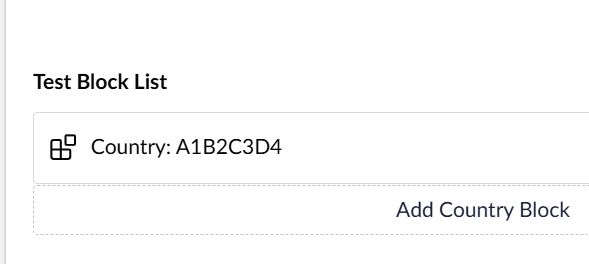
So, I’m trying to create an extension for the UFM labels, to retrieve the “Name” of an Umbraco Commerce Entity. In this case a ‘country’.
I have a block-list where you select a country per block. I want the name of that country to show up in the blocklist. So I started with the UFM label: Country: {=country}. This works, but it returns the GUID of the country.
So I asked Claude Chat for assistance, and after a couple of tries I ended up with the following files:
umbraco-package.json
{
	"name": "Commerce Country Name UFM",
	"extensions": [
		{
			"type": "ufmComponent",
			"alias": "My.Commerce.CountryName",
			"name": "Commerce Country Name",
			"api": "/App_Plugins/commerceCountryName/commerce-country-name.component.js",
			"meta": {
				"alias": "commerceCountryName"
			}
		},
		{
			"type": "bundle",
			"alias": "My.Commerce.CountryName.Bundle",
			"name": "Commerce Country Name Bundle",
			"js": "/App_Plugins/commerceCountryName/commerce-country-name.element.js"
		}
	]
}
commerce-country-name.component.js
import { UmbUfmComponentBase } from '@umbraco-cms/backoffice/ufm';
import './commerce-country-name.element.js';

export class CommerceCountryNameApi extends UmbUfmComponentBase {
    async render(token) {
        const alias = token.text?.trim();
        return `<commerce-country-name property-alias="${alias}"></commerce-country-name>`;
    }
}

export { CommerceCountryNameApi as api };
commerce-country-name.element.js
import { UmbLitElement } from '@umbraco-cms/backoffice/lit-element';
import { html } from '@umbraco-cms/backoffice/external/lit';
import { UMB_BLOCK_ENTRY_CONTEXT } from '@umbraco-cms/backoffice/block';

class CommerceCountryNameElement extends UmbLitElement {
    static properties = {
        propertyAlias: { type: String, attribute: 'property-alias' },
        _countryName: { type: String, state: true },
    };

    constructor() {
        super();
        this.propertyAlias = '';
        this._countryName = '';
        console.log('constructor hit');
    }

    async connectedCallback() {
        console.log('callback');
        super.connectedCallback();

        // Haal de GUID op via de block entry context
        this.consumeContext(UMB_BLOCK_ENTRY_CONTEXT, async (context) => {
            if (!context) return;

            const content = context.content;
            const guid = content?.getValueByAlias(this.propertyAlias);

            console.log('Country GUID:', guid);

            if (guid) {
                await this._fetchCountryName(guid);
            }
        });
    }

    async _fetchCountryName(guid) {
        console.log('get');
        try {
            const response = await fetch(
                `/umbraco/commerce/storefront/api/v1/country/${guid}`,
                { credentials: 'include' }
            );

            if (response.ok) {
                const data = await response.json();
                this._countryName = data.name ?? guid;
            } else {
                this._countryName = guid;
            }
        } catch {
            this._countryName = guid;
        }
    }

    render() {
        return html`${this._countryName}`;
    }
}

customElements.define('commerce-country-name', CommerceCountryNameElement);
The label in my blocklist now reads Country: [object Promise]
And I don’t see the console.log() lines I put in the Callback or Constructor.
I haven’t got any experience with extension development in U17 other than modifying a file here or there. So it might be something super simple. But I don’t know why the element’s constructor isn’t called. And Claude is comming up with solutions that only confuse me more, and don’t work either 
Any help is appreciated!