Using Umbraco 17.1.0 currently, we are facing a weird issue where the automatic url tracking redirect thing isn’t working.
Opening the panel at Content > Redirects manager gives this error:
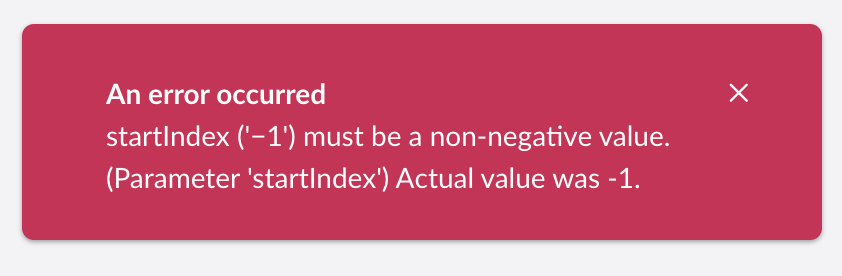
The fail comes from the backoffice request to umbraco/management/api/v1/redirect-management?take=20&skip=0
The response is:
{
    "type": "Error",
    "title": "startIndex ('−1') must be a non-negative value. (Parameter 'startIndex')\nActual value was -1.",
    "status": 500,
    "detail": "   at System.ArgumentOutOfRangeException.ThrowNegative[T](T value, String paramName)\n   at System.String.ThrowSubstringArgumentOutOfRange(Int32 startIndex, Int32 length)\n   at Umbraco.Cms.Core.Routing.NewDefaultUrlProvider.GetUrlFromRoute(String route, Int32 id, Uri current, UrlMode mode, String culture)\n   at Umbraco.Cms.Core.Routing.UrlProvider.GetUrlFromRoute(Int32 id, String route, String culture)\n   at Umbraco.Cms.Api.Management.Factories.RedirectUrlPresentationFactory.Create(IRedirectUrl source)\n   at Umbraco.Cms.Api.Management.Factories.RedirectUrlPresentationFactory.CreateMany(IEnumerable`1 sources)+MoveNext()\n   at System.Text.Json.Serialization.Converters.IEnumerableDefaultConverter`2.OnWriteResume(Utf8JsonWriter writer, TCollection value, JsonSerializerOptions options, WriteStack& state)\n   at System.Text.Json.Serialization.JsonCollectionConverter`2.OnTryWrite(Utf8JsonWriter writer, TCollection value, JsonSerializerOptions options, WriteStack& state)\n   at System.Text.Json.Serialization.Metadata.JsonPropertyInfo`1.GetMemberAndWriteJson(Object obj, WriteStack& state, Utf8JsonWriter writer)\n   at System.Text.Json.Serialization.Converters.ObjectDefaultConverter`1.OnTryWrite(Utf8JsonWriter writer, T value, JsonSerializerOptions options, WriteStack& state)\n   at System.Text.Json.Serialization.JsonConverter`1.WriteCore(Utf8JsonWriter writer, T& value, JsonSerializerOptions options, WriteStack& state)\n   at System.Text.Json.Serialization.Metadata.JsonTypeInfo`1.SerializeAsync(PipeWriter pipeWriter, T rootValue, Int32 flushThreshold, CancellationToken cancellationToken, Object rootValueBoxed)\n   at System.Text.Json.Serialization.Metadata.JsonTypeInfo`1.SerializeAsync(PipeWriter pipeWriter, T rootValue, Int32 flushThreshold, CancellationToken cancellationToken, Object rootValueBoxed)\n   at System.Text.Json.Serialization.Metadata.JsonTypeInfo`1.SerializeAsync(PipeWriter pipeWriter, T rootValue, Int32 flushThreshold, CancellationToken cancellationToken, Object rootValueBoxed)\n   at Microsoft.AspNetCore.Mvc.Formatters.SystemTextJsonOutputFormatter.WriteResponseBodyAsync(OutputFormatterWriteContext context, Encoding selectedEncoding)\n   at Microsoft.AspNetCore.Mvc.Infrastructure.ResourceInvoker.<InvokeNextResultFilterAsync>g__Awaited|30_0[TFilter,TFilterAsync](ResourceInvoker invoker, Task lastTask, State next, Scope scope, Object state, Boolean isCompleted)\n   at Microsoft.AspNetCore.Mvc.Infrastructure.ResourceInvoker.Rethrow(ResultExecutedContextSealed context)\n   at Microsoft.AspNetCore.Mvc.Infrastructure.ResourceInvoker.InvokeResultFilters()\n--- End of stack trace from previous location ---\n   at Microsoft.AspNetCore.Mvc.Infrastructure.ResourceInvoker.<InvokeNextResourceFilter>g__Awaited|25_0(ResourceInvoker invoker, Task lastTask, State next, Scope scope, Object state, Boolean isCompleted)\n   at Microsoft.AspNetCore.Mvc.Infrastructure.ResourceInvoker.Rethrow(ResourceExecutedContextSealed context)\n   at Microsoft.AspNetCore.Mvc.Infrastructure.ResourceInvoker.Next(State& next, Scope& scope, Object& state, Boolean& isCompleted)\n   at Microsoft.AspNetCore.Mvc.Infrastructure.ResourceInvoker.InvokeFilterPipelineAsync()\n--- End of stack trace from previous location ---\n   at Microsoft.AspNetCore.Mvc.Infrastructure.ResourceInvoker.<InvokeAsync>g__Awaited|17_0(ResourceInvoker invoker, Task task, IDisposable scope)\n   at Microsoft.AspNetCore.Mvc.Infrastructure.ResourceInvoker.<InvokeAsync>g__Awaited|17_0(ResourceInvoker invoker, Task task, IDisposable scope)\n   at Umbraco.Cms.Web.Common.Middleware.BasicAuthenticationMiddleware.InvokeAsync(HttpContext context, RequestDelegate next)\n   at Microsoft.AspNetCore.Builder.UseMiddlewareExtensions.InterfaceMiddlewareBinder.<>c__DisplayClass2_0.<<CreateMiddleware>b__0>d.MoveNext()\n--- End of stack trace from previous location ---\n   at Umbraco.Cms.Api.Management.Middleware.BackOfficeExternalLoginProviderErrorMiddleware.InvokeAsync(HttpContext context, RequestDelegate next)\n   at Microsoft.AspNetCore.Builder.UseMiddlewareExtensions.InterfaceMiddlewareBinder.<>c__DisplayClass2_0.<<CreateMiddleware>b__0>d.MoveNext()\n--- End of stack trace from previous location ---\n   at cms.DeliveryApiResponseLoggingMiddleware.InvokeAsync(HttpContext context) in /home/vsts/work/1/s/umbracocms/infrastructure/DeliveryApiTracingMiddleware.cs:line 52\n   at cms.DeliveryApiTracingMiddleware.InvokeAsync(HttpContext context) in /home/vsts/work/1/s/umbracocms/infrastructure/DeliveryApiTracingMiddleware.cs:line 31\n   at Swashbuckle.AspNetCore.SwaggerUI.SwaggerUIMiddleware.Invoke(HttpContext httpContext)\n   at Swashbuckle.AspNetCore.Swagger.SwaggerMiddleware.Invoke(HttpContext httpContext, ISwaggerProvider swaggerProvider)\n   at Microsoft.AspNetCore.Session.SessionMiddleware.Invoke(HttpContext context)\n   at Microsoft.AspNetCore.Session.SessionMiddleware.Invoke(HttpContext context)\n   at Microsoft.AspNetCore.Localization.RequestLocalizationMiddleware.Invoke(HttpContext context)\n   at Microsoft.AspNetCore.Authorization.AuthorizationMiddleware.Invoke(HttpContext context)\n   at Microsoft.AspNetCore.Authentication.AuthenticationMiddleware.Invoke(HttpContext context)\n   at Skybrud.Umbraco.Redirects.Middleware.RedirectsMiddleware.InvokeAsync(HttpContext context)\n   at Umbraco.Cms.Web.Common.Middleware.ProtectRecycleBinMediaMiddleware.InvokeAsync(HttpContext context, RequestDelegate next)\n   at Microsoft.AspNetCore.Builder.UseMiddlewareExtensions.InterfaceMiddlewareBinder.<>c__DisplayClass2_0.<<CreateMiddleware>b__0>d.MoveNext()\n--- End of stack trace from previous location ---\n   at StackExchange.Profiling.MiniProfilerMiddleware.Invoke(HttpContext context) in C:\\projects\\dotnet\\src\\MiniProfiler.AspNetCore\\MiniProfilerMiddleware.cs:line 112\n   at Umbraco.Cms.Web.Common.Middleware.UmbracoRequestMiddleware.InvokeAsync(HttpContext context, RequestDelegate next)\n   at Umbraco.Cms.Web.Common.Middleware.UmbracoRequestMiddleware.InvokeAsync(HttpContext context, RequestDelegate next)\n   at Microsoft.AspNetCore.Builder.UseMiddlewareExtensions.InterfaceMiddlewareBinder.<>c__DisplayClass2_0.<<CreateMiddleware>b__0>d.MoveNext()\n--- End of stack trace from previous location ---\n   at Umbraco.Cms.Web.Common.Middleware.PreviewAuthenticationMiddleware.InvokeAsync(HttpContext context, RequestDelegate next)\n   at Microsoft.AspNetCore.Builder.UseMiddlewareExtensions.InterfaceMiddlewareBinder.<>c__DisplayClass2_0.<<CreateMiddleware>b__0>d.MoveNext()\n--- End of stack trace from previous location ---\n   at Umbraco.Cms.Web.Common.Middleware.UmbracoRequestLoggingMiddleware.InvokeAsync(HttpContext context, RequestDelegate next)\n   at Microsoft.AspNetCore.Builder.UseMiddlewareExtensions.InterfaceMiddlewareBinder.<>c__DisplayClass2_0.<<CreateMiddleware>b__0>d.MoveNext()\n--- End of stack trace from previous location ---\n   at Microsoft.AspNetCore.Diagnostics.ExceptionHandlerMiddlewareImpl.<Invoke>g__Awaited|10_0(ExceptionHandlerMiddlewareImpl middleware, HttpContext context, Task task)",
    "instance": "ArgumentOutOfRangeException"
}
Any idea how to get this working again?